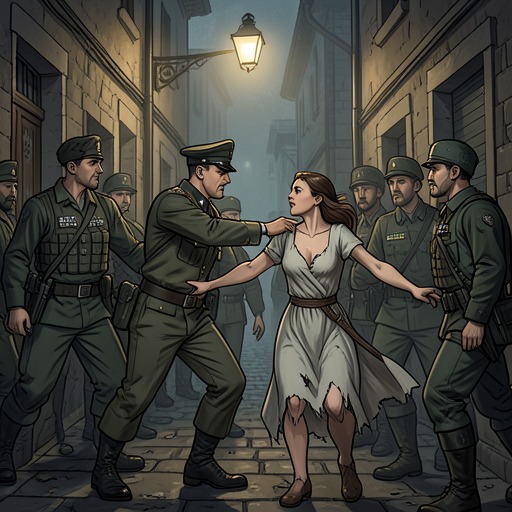
Esther Kubis
The Zone of InterestEsther Kubis is a fifteen-year-old Sephardic prisoner at the camp whose blunt resolve outlasts repeated attempts to turn her into a manageable object of punishment or display. First seen clearing rubble and later confined in Bunker 11, she is also made a star of a ballet production. The contrast is not a passage from captivity to freedom: even onstage, Esther remains under guard, and the book ultimately leaves her fate unknown.
Identity and First Appearance
Esther belongs to the Clearance Detail, one of a rotating group of two or three hundred girls working in a yard the size of a soccer field, cluttered with sheds. The narrator notices her dark crewcut and describes her as fifteen, Sephardic, finely built and athletic. Her trudging, heavy gait seems at odds with that physical description, an early contrast between a body capable of movement and the weight the camp imposes on it.
When Boris Eltz summons her to his office, she is squeezing toothpaste from tubes into a cracked pitcher. He taps on the glass with his fountain pen until she looks up; Esther rolls her eyes and returns to her task. The gesture gives her a small, unsentimental refusal to perform interest or gratitude for the people who command her. Boris calls her in and asks her to take a postcard, but his attention to her is already bound up with a more consequential history: he says he intervened after she was caught entering the camp without hair and was assigned to the waste detail.
Rescue, Defiance, and Punishment
Before her arrival at the camp, Esther had been clawing rubble in Monowitz. A cousin secretly got her into the camp, but her lack of hair exposed her and led to her assignment to the Scheissekommando. Boris says he rescued her by manipulating the camp’s exchanges of favors: in his words, “you just rob Peter to bribe Paul.” His intervention did not make Esther his grateful dependent. When the narrator points out that she hates him, Boris bitterly agrees.
Boris later explains that Esther had privately resolved, “I don’t like it here and I’m not going to die here.” He treats her subsequent conduct as an expression of that resolve. The book identifies the act that brings her into renewed danger as political sabotage, not a minor infraction. Esther is put in Bunker 11. Boris first thinks about getting her food and water that night, then decides that a couple of days inside will teach her a lesson. His concern for her survival coexists with a willingness to make her endure deprivation, exposing the limits—and the coercive underside—of his protection.
Her danger sharpens when Boris is sent to Goleschau for nearly two weeks. Before leaving, he makes getting Esther out of Block 11 his priority because she would otherwise starve. Since she is now held by the Gestapo, he looks for someone who can secure her release: the official he first might have approached is away, as is that man’s deputy. Esther’s survival thus depends not only on her own refusal to yield but on the contingent arrangements of people with access to camp authority. The account does not turn Boris’s intervention into a guarantee of safety; it shows how easily a prisoner’s access to food can depend on whether a powerful intermediary is present.
Made a Star: Esther and Coppelia
Esther’s place in a camp ballet brings another form of control into view. In a warehouse-sized structure lined with bunk beds and equipment under tarps, Boris peers through a window and sees her. She receives triple rations because the performers have to care for their “big star.” But Esther has not escaped the camp’s hierarchy: Ilse Grese supervises the rehearsal in full uniform, with her whip at her belt, and Esther is among a group of girl prisoners being organized into a slow waltz. The privilege attached to performance is conditional and exists inside the machinery of confinement.
Before the performance, Boris predicts that Esther will fail on purpose and tells the narrator that the war is lost. When Coppelia begins, Esther appears as the life-size marionette in Dr Coppelius’s workshop. She sits rigidly on a straight-backed chair in a tutu, spangled white tights, and bright pink slippers, reading a book upside down until Coppelius corrects her. The first impression is not of a dancer freely inhabiting the role but of a body held still amid dolls, dummies, and the stage’s manufactured magic.
Then the performance changes. The narrator describes the charm taking hold: Esther’s inert expression becomes a willed, blissful smile, and she moves into a tour jeté that seems to glide upward, her muscles still straining as if they needed to fly higher. The audience warms and murmurs. Yet the narrator cannot find the movement easy to watch. Boris, who has been waiting for her appearance, gets to his feet and leaves, bent over with his arm raised to his face. The scene offers no simple confirmation that Esther either succeeds or fails on the terms Boris predicted. Instead, the visible transformation into a dancer remains inseparable from the coercive setting and from the painful response it provokes in him.
Last Meeting and Unknown Fate
The narrator’s last sight of Esther is on May 1, 1943, in a sealed Block where the two are alone. He is about to be sent to another camp, Oranienburg; Esther is serving the final hours of a three-day confinement without food or water. Her alleged offense concerns making her bed, or failing to make it properly—a measure of how an ordinary task can become a means of punishment under Ilse Grese’s exacting authority.
They talk for almost two hours. The narrator tells Esther that Boris had extracted a promise from him to do everything in his power for her, but that he can no longer keep it: he has nothing to offer her, not even his wristwatch. He thinks Esther listens closely because he is now plainly on the wrong side of the Reich. She also seems to infer that Boris may not be what he appears to be; the narrator does not correct her. He urges her to stay alive long enough to witness Germany’s defeat. The promise is not a rescue plan, but a last appeal made in a moment when he has no material protection to give.
When the narrator wakes, Esther stands with her forearms on a windowsill, gazing toward the mountains of the Sudetenland. He knows she was born and raised in the High Tatras, whose peaks were capped with ice, and reads her frown and half-smile as signs that she is absorbed in memory. Hedwig Butefisch approaches quietly and gives her a playful pinch on the back of the thigh. The two briefly wrestle and laugh; then Ilse Grese calls from the doorway. They immediately straighten, and Hedwig marches her prisoner out into the air. In a few seconds the scene shifts from private play to the camp’s restored discipline.
The book gives no later confirmation of Esther’s survival. The narrator explicitly says her fate is unknown to him, while recalling Boris’s belief that she would not go under and that her spirit would deny her persecutors the satisfaction. He remembers, too, the sentence Boris often cited as Esther’s first declaration of intent: she did not like the camp and would not die there. Her ending remains unresolved; what persists is the tension between that stated refusal and the power that repeatedly confines her.